0M
adults live with diabetes
Projected to reach 783M by 2045.
Two fingers, five wavelengths of light and an adaptive AI engine. WDP estimates blood glucose and HbA1c to flag diabetes and prediabetes early, before the damage begins.
Diabetes rarely announces itself. By the time symptoms appear, years of high glucose may already have damaged nerves, kidneys, eyes and the heart. Screening is the cheapest moment to intervene, and today it still needs a lab, a needle and a follow-up visit.
Projected to reach 783M by 2045.
Almost 1 in 2 adults with diabetes have never been told.
The prediabetes window where progression can still be reversed.
Spent on diabetes care worldwide, mostly on late complications.
Source: IDF Diabetes Atlas, 10th edition (2021).
Glycaemic damage builds silently over years. WDP is designed for the moment when lifestyle change and early treatment still work best, turning screening from a lab event into a 20-second check that fits in a school, a pharmacy or a prenatal clinic.
Uncontrolled gestational diabetes can drive excessive fetal growth and a falling fetal heart rate, and in the worst cases stillbirth. When the placenta can't deliver enough nutrition and oxygen, brain development can be affected for life. Our team has lived this. We detected gestational diabetes in a family member with our own prototype, and later flagged diabetes in a parent who insisted he was healthy. The laboratory confirmed both.
Early detection protects the child, the family and the healthcare system. That is what WDP is built for.
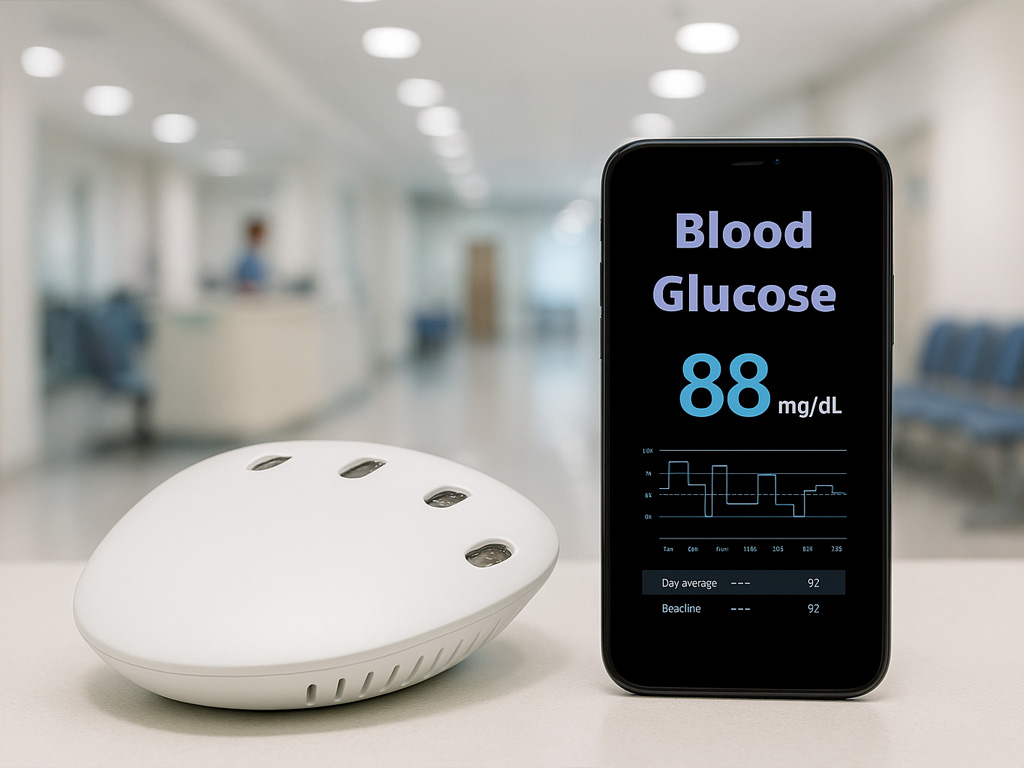
WDP works like two synchronised pulse oximeters on the index and middle fingers, upgraded with five optical channels and an on-device AI that turns thousands of light measurements into a glucose and HbA1c estimate.
Dual-point clips on the index and middle finger. Measuring two sites at once cancels much of the noise that defeated single-point attempts.
Five sensors at specific wavelengths record thousands of data points. They separate the glucose signal from water, protein, fat, blood concentration and skin thickness.
A multi-layer model, in development since 2020, estimates glucose and HbA1c. In personal mode it calibrates to its user over seven days and keeps improving with every reading.
Normal Prediabetes Diabetes. A clear, instant triage that refers the right people to confirmatory lab testing.
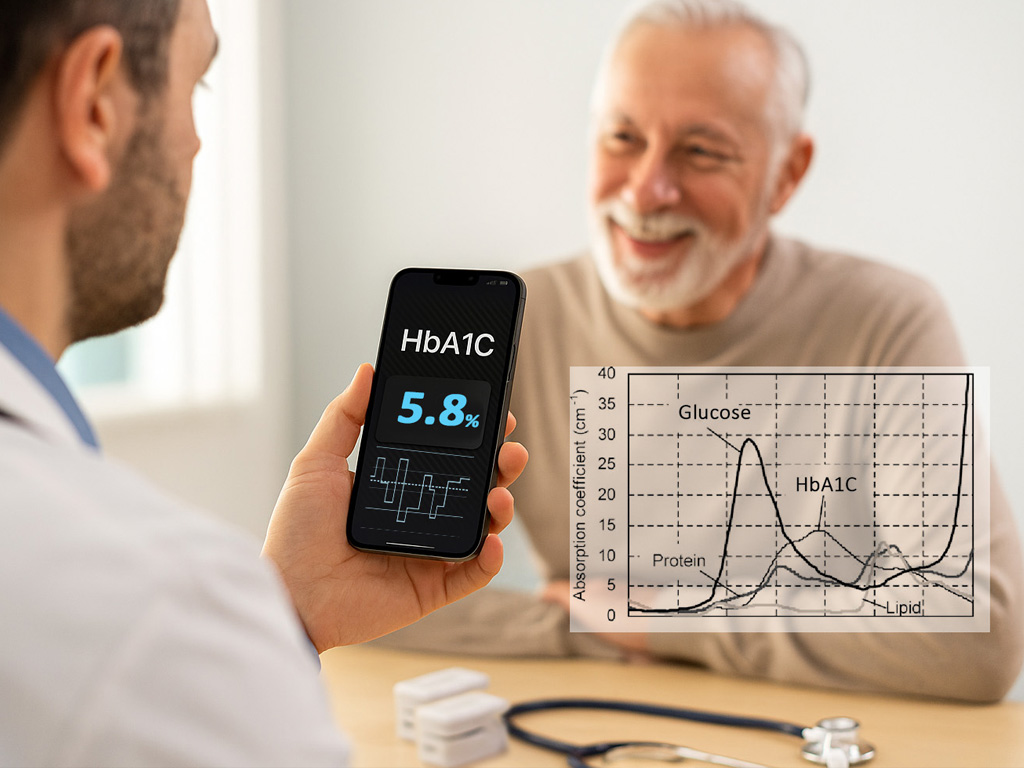
Glucose, water, protein and lipids absorb light differently across the near-infrared. By reading several wavelengths at once and modelling the interference mathematically, WDP isolates the signal that matters.
WDP V8 is a working device, the result of more than five years of engineering, six hardware generations and two years of clinical testing. It is not a concept render.
Index and middle finger are measured simultaneously for redundancy and noise rejection.
Purpose-selected emitters plus a receiver in every probe, on custom-designed circuit boards.
Signal processing and prediction run on the device. Results appear without a lab round-trip.
Glucose (mg/dL), estimated HbA1c (%) and a green, yellow or red status anyone can read.
Results sync to a mobile app for history, trends and program-level screening dashboards.
Current production cost per unit, expected to fall significantly with volume manufacturing.
Over two years, six device versions were evaluated at a leading diabetes centre. Every volunteer had a standard laboratory blood test and was immediately measured with the device, so each reading has a lab reference to compare against.
Device versus laboratory glucose across clinical testing (ADA 2025).
Non-invasive HbA1c estimation, the gold-standard screening marker.
For glucose below 100 mg/dL in the hold-out test set (n = 161).
Overall, hold-out test set in an 805-participant venous-reference study.
| WDP V8 | Lab HbA1c | Finger-prick meter | CGM | |
|---|---|---|---|---|
| Needles or blood | None | Venous draw | Lancet every test | Sensor under skin |
| HbA1c (screening marker) | Estimated | Yes | No | No |
| Time to result | ~20 s | Hours to days | Seconds | Continuous, lags 3–30 min |
| Cost per test | Near zero | Lab fee + visit | Strip per test | $1,000–2,500 / month (US) |
| Mass screening in schools and communities | Designed for it | Impractical | Invasive | Not suitable |
| Visible on the body | No | No | No | Yes |
Painless screening children don't fear. Find type 2 and prediabetes in adolescents before habits harden.
Fast, repeatable risk checks during pregnancy that refer at-risk mothers to confirmatory testing early.
Population screening at a fraction of lab cost, for ministries of health and payers.
Point-of-care triage at the counter, with no phlebotomy, no sharps and no waiting.
Corporate wellness and risk programs that reach people before claims do.
A low-cost, reusable device for regions where labs are far away.
The Middle East and North Africa had 73 million adults with diabetes in 2021, a number projected to rise 87% by 2045, the fastest growth of any developed region. We start there and scale to the world's largest healthcare markets.
Beachhead market. Government-led screening programs, school health and pharmacy networks. Regional presence and advisory network in Abu Dhabi.
FDA pathway led by our clinical-trials director. Clinical partners in California and New York. Corporate wellness and payer channels.
CE / MDR route for point-of-care screening in primary care, pharmacies and national prevention programs.
Among the first teams worldwide to apply adaptive multi-layer AI to blood glucose and biomarker monitoring.
Successive hardware generations, custom circuit boards and sensor optimisation reduce the measurement to two fingers.
Six device versions evaluated against laboratory references over two years.
Results presented internationally. Abstract published. U.S. patent secured.
Screening-focused device and app. Peer-reviewed manuscript in process. New patent filing for the V8 invention.
GCC screening pilots, multi-centre validation and FDA / CE submissions.
Professor of Public Health and Epidemiology, Khalifa University, Abu Dhabi. Deep networks across GCC and Asian innovation and investor ecosystems.
Endocrinologist, Department of Diabetes, Endocrinology and Metabolism, City of Hope National Medical Center, California. Corresponding author of the WDP clinical study.
Biomedical engineer and AI specialist. Has built adaptive AI for non-invasive biomarker monitoring since 2020. Holds five patents, including a gold-medal invention. Springer Nature reviewer.
Friedman Diabetes Institute, Lenox Hill Hospital, Northwell Health, and the Feinstein Institutes for Medical Research, New York.
Institutional affiliations are listed for identification only and do not imply institutional endorsement.
We are partnering with investors and health systems in the UAE, GCC, United States and Europe to fund clinical validation, regulatory approval and the first national screening pilots.